BresoTec, formerly known as ApneaDx, also among top five finalists
TORONTO, August 11, 2015 – Legworks‘ next-generation prosthetic knee took first place in Ontario Centres of Excellence’s (OCE’s) Parapan Am Games-affiliated Accessibility Tech Pitch competition. The company immediately said it would use the $20,000 award to fit 200 amputees in developing countries with its device.
Legworks was selected from 18 participants in a two-day elimination pitch competition – one of the features of the Government of Ontario’s Accessibility Innovation Showcase held at MaRS Discovery District from August 8 to 10, 2015.
Legworks was one of five companies to make it to the final round of the competition.
Other finalists were Eightfold Technologies, MyndTec, BresoTec Inc., and Komodo OpenLabs. BresoTec Inc., formerly known as ApneaDx Inc., is a MaRS Innovation start-up company spun-off in partnership with the University Health Network’s Toronto Rehabilitation Institute and is developing a medical device to allow patients to determine whether they have sleep apnea without having to visit a sleep clinic.
MI’s Fazila Seker also interviewed in National Post article on what prompts medical researchers to consider crowdfunding
The WaveCheck crowdfunding campaign, which raised $53,390 on Indiegogo to support clinical trials for a clinical technique invented by researchers at Sunnybrook Health Sciences Centre and Ryerson University, was included in a new Canadian-led study on the merits of crowdfunding to support cancer and rare diseases.
MaRS Innovation has confirmed with lead author Professor Nick Dragojlovic of the University of British Columbia that WaveCheck was among the campaigns included in the study.
OICR’s catalyst grant enables WaveCheck to open first partner site at MD Anderson Cancer Center in May
TORONTO, April 8, 2014 — People with breast cancer are a step closer to knowing if their tumour is responding to chemotherapy at the start of treatment, thanks to a $100,000 catalyst grant from the Ontario Institute for Cancer Research (OICR).
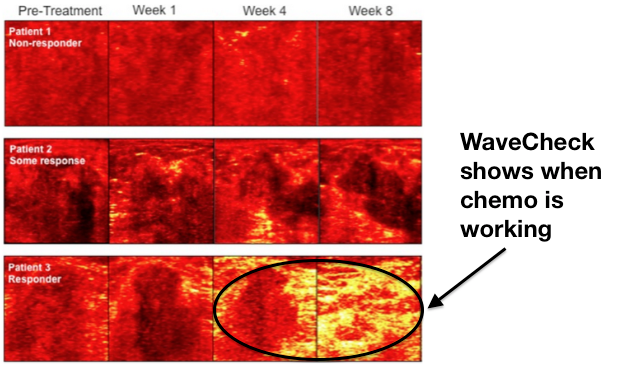
WaveCheck, a clinical technique invented, refined and tested by scientists at Sunnybrook Health Sciences Centre and Ryerson University over 20 years, aims to show whether chemotherapy is actually destroying a breast cancer tumour at the beginning of chemotherapy treatment (in as little as four weeks), rather than at the end of treatment (typically four to six months).
In early clinical testing, WaveCheck’s inexpensive, non-invasive, image-guided technology (shown here) shows promise as an accurate, efficient way to monitor tumour response. As of March 2015, Sunnybrook has partnered with GE Healthcare to co-develop WaveCheck as a clinical tool.
In early clinical testing, the non-invasive, image-guided technology has shown promise as an accurate, efficient way to monitor tumour response, opening the door to tailored treatment.
“This is a significant step towards achieving the goal of personalized medicine. The clinical trials will confirm that information provided by WaveCheck can determine if the treatment is the appropriate one or that other options should be chosen, sparing patients the side effects of treatments that will not likely be successful,” said Dr. Tom Hudson, OICR’s president and scientific director. “If successful, WaveCheck could become a standard tool in the cancer treatment of the future.”
MI’s Fazila Seker and Elizabeth Monier-Williams, campaign co-directors for WaveCheck, were featured in a MedCity News article about successfully crowdfunding in the healthcare field.
The article, in MedCity News‘ Hot Topics section, questions whether a crowdfunding campaign needs to reach its funding goal to be deemed successful.
Seker and Monier-Williams completed an Indiegogo crowdfunding campaign in December for WaveCheck, a clinical technique developed to let women and men know if their breast cancer chemotherapy is working within weeks of beginning treatment instead of months later when treatment has already ended.
Here’s an excerpt from the article:
Fazila Seker, the director of technology and venture development at commercialization agency MaRS Innovation, said that one of the trickiest things about the crowdfunding industry is the notion that these platforms have an established crowd that’s lurking around looking for the next best thing.
“You can’t rely entirely on that,” she said. “You need to go out there and do your research and create your own following.”
Bedside Clinical Systems and their flagship product, Bedside PEWS™, were featured in the February 2014 issue of Hospital News.
Bedside Clinical Systems‘ (BCS) flagship product, the Bedside Paediatric Warning System or BedSidePEWS™, was covered in the February 2014 edition of Hospital News.
The article, written by Rajesh Sharma who is president and CMO of BCS, explains how the technology helps decrease the amount of code blues in paediatric patients.
Invented by Dr. Christopher Parshuram of the Hospital of Sick Children (SickKids), Bedside PEWS™ is now in three hospitals in Canada, the United States and New Zealand. The technology received FDA approval last year.
Here’s an excerpt from the article:
The program digitally logs, charts, and evaluates seven vital sign items thst sre part of routine clinical assessments and then summarizes them into a singly score. From the BedsidePEWS™ score, care providers can better match the level of care with the patient’s required needs, thereby improving patient outcomes and reducing the number of urgent calls, code blue incidents and related deaths.
“Identifying at-risk patients is significant since approximately 5,000 children in North America experience a code blue event each year, from which too many children die or sustain neurological deficit. BedsidePEWS™ hopes to improve outcomes for these patients and their families,” says Dr. Parshuram.
Deal led by MaRS Innovation and Innovation York to strengthen Slyce’s mobile image recognition application for retail e-commerce
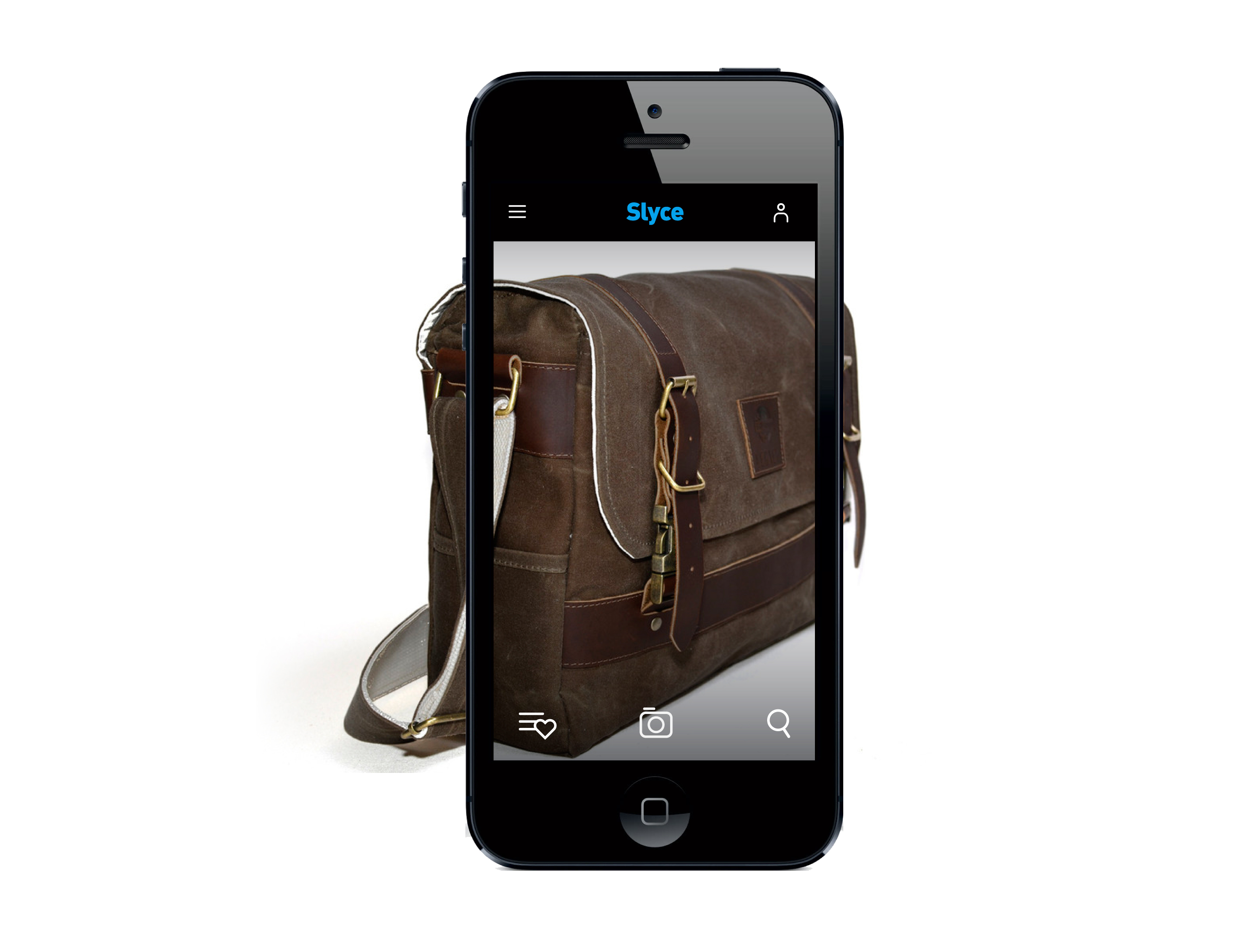
York’s technology will help Slyce in developing a mobile app that can be used to take pictures of a product in-store, enabling a user to purchase the item from the retailer immediately on his or her smartphone.
TORONTO, Feb. 4, 2014—Slyce today announced that it has acquired a computer vision technology developed at York University that quickly analyzes and aggregates similar images.
Through the acquisition, Slyce also hired former York PhD student, Dr. Ehsan Fazl-Ersi, to lead the integration of the intellectual property into Slyce’s Visual Search Platform as their new head of Research & Development.
Slyce is a premium provider of visual search technology for retailers, brands and publishers. Their platform allows customers to take a picture of real-world products with their smartphone and then find direct or close-matching products from the retailer’s catalogue, which they are able to purchase on the spot.
“Identifying and classifying an object captured within a scene is difficult due to the effects of background clutter, lighting variations and viewpoint changes on the object’s appearance,” says Fazl-Ersi, who designed and developed the technology with his PhD supervisor, Dr. John K. Tsotsos, a professor in the Lassonde School of Engineering’s Department of Electrical Engineering and Computer Science, and a member and former director of York’s Centre for Vision Research.
“This is a much bigger problem for mobile applications where the algorithm’s speed and efficiency are the difference between losing a consumer or making a sale,” says Fazl-Ersi. “Our technology will provide higher accuracy when quickly identifying retail items so that consumers can choose among similar items according to style, colour or pattern using a mobile device.”
The researchers partnered with MaRS Innovation and Innovation York, York’s commercialization office, to file patent protection on the initial technology, develop a commercialization plan, secure grant funding, facilitate business development meetings and negotiate the resulting transaction.
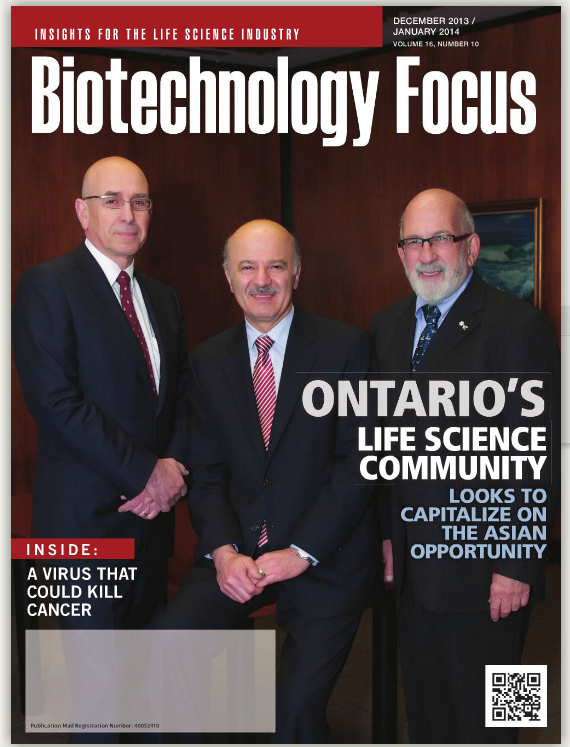
MI’s Dr. Raphael Hofstein (left), the Honourable Minister Reza Moridi (centre) and Dr. Mark Poznansky of the Ontario Genome Institute on the January 2014 cover of Biotechnology Focus.
In a January 24, 2014 Biotechnology Focuscover article, author Shawn Lawrence discusses MaRS Innovation President and CEO Dr. Raphael (Rafi) Hofstein‘s recent visit to learn more of the emerging science and technology markets in Singapore and Japan.
The trip allowed Hofstein to discuss current MI projects, specifically start-ups XLV Diagnostics Inc. and DVLR Therapeutics Inc., whose products could benefit from Singapore’s proximity to medical technology markets in India and China.
2013 was an exceptional year for MaRS Innovation. Here are the top 10 news stories from our commercialization portfolio. 1. MaRS Innovation secures a $15 million CECR funding extension In January,…
MaRS Innovation’s commercialization process helps inventors move their transformational ideas from the lab bench to the market.
Johnson & Johnson Innovation and its affiliate Janssen Inc. in Canada announced new collaborations with two Canadian early-stage drug technology development centres, Montreal-based NEOMED and Toronto-based MaRS Innovation, to identify and advance promising bio/pharmaceutical technologies that have the potential to impact human health.
Through these collaborations, technical experts from the Johnson & Johnson Innovation Center in Boston, Massachusetts will work with NEOMED and MaRS Innovation to identify investment opportunities emerging from well-validated scientific research discoveries within their communities of academic institutions and biotechnology companies.
“Breast Cancer Awareness Month’s positivity makes it easy to overlook the fact that 60 to 70 per cent of chemotherapy treatments fail,” says Dr. Gregory Czarnota, chief of Radiation Oncology at Sunnybrook Health Sciences Centre and co-inventor of WaveCheck with Professor Michael C. Kolios of Ryerson University. “WaveCheck’s technology can tell people with breast cancer and their doctors if a particular chemotherapy is working in as little as four weeks.”

 TORONTO, August 11, 2015 – Legworks‘ next-generation prosthetic knee took first place in Ontario Centres of Excellence’s (OCE’s) Parapan Am Games-affiliated Accessibility Tech Pitch competition. The company immediately said it would use the $20,000 award to fit 200 amputees in developing countries with its device.
 Other finalists were Eightfold Technologies, MyndTec, BresoTec Inc., and Komodo OpenLabs. BresoTec Inc., formerly known as ApneaDx Inc., is a MaRS Innovation start-up company spun-off in partnership with the University Health Network’s Toronto Rehabilitation Institute and is developing a medical device to allow patients to determine whether they have sleep apnea without having to visit a sleep clinic.